
Courtyard's Public Growth Loop—and the Collector Identity Test It Should Run Next
What Courtyard's public product and scale evidence establishes, what remains unknowable, and how to test an opt-in collector identity layer.
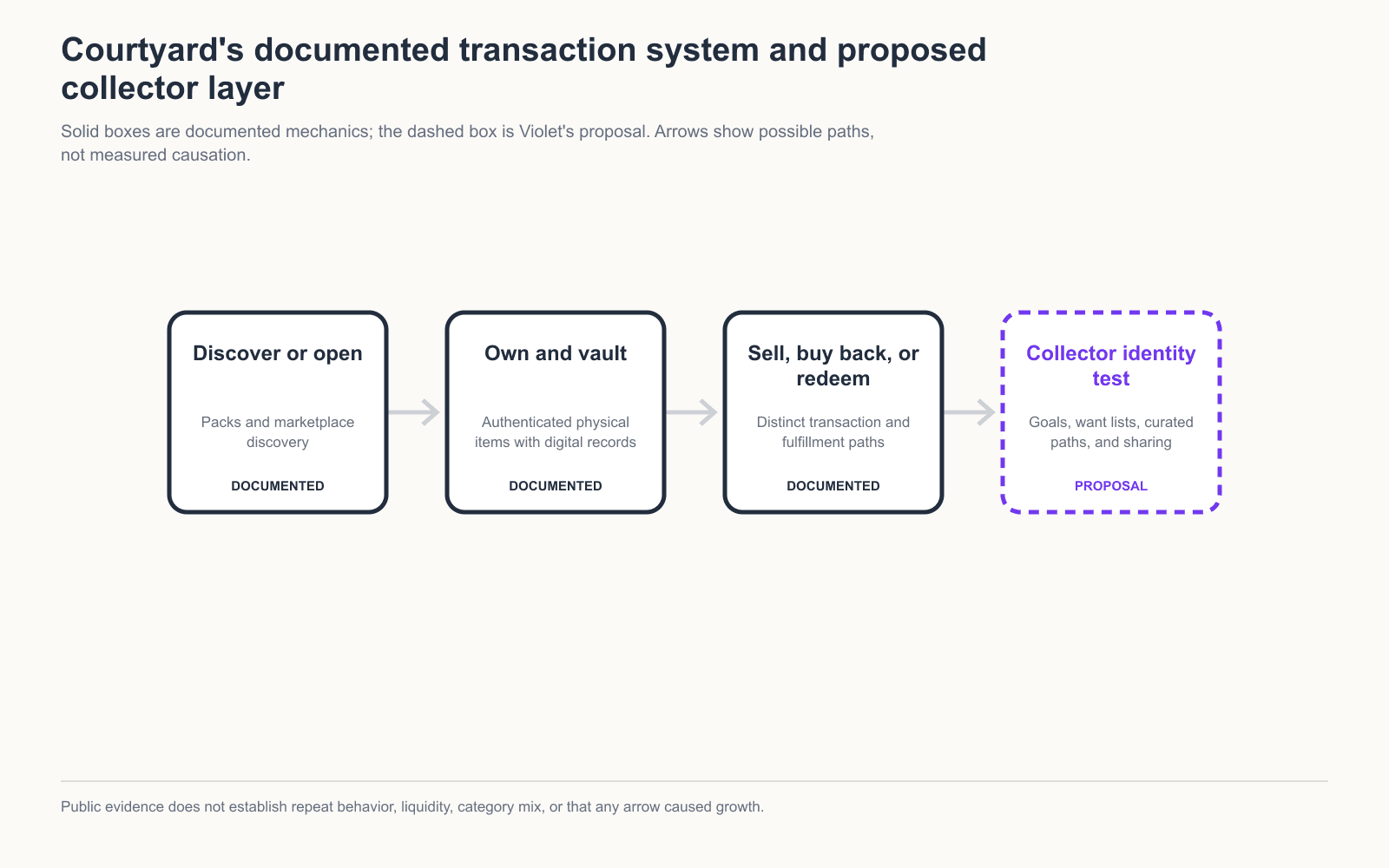
Courtyard’s public evidence documents a transaction and fulfillment system plus reported scale, but it does not establish retention, category mix, liquidity, or which mechanic caused growth. The evidence supports a collector-identity experiment only as Violet’s measurable proposal.
The useful external conclusion is therefore bounded. Courtyard has made several parts of collecting legible and transactable, while the public record cannot show whether buyers become durable collectors or which product path matters most.
The next move is not to assert that a social feature will create retention. It is to isolate one collector-identity intervention, pre-register the outcome and guardrails, and let a comparison group decide whether the idea deserves to scale.
At a glance
| Question | Public-data answer |
|---|---|
| What is documented? | Authentication, packs and marketplace transactions, vaulting, resale or buyback paths, and redemption. |
| What scale is reported? | Two monthly GMV labels, reported by the company and coverage, that cannot be joined into a rate. |
| What changed recently? | Public launches expanded into coins and memorabilia in June and July 2026. |
| What remains unknown? | Users, retention, category mix, liquidity, compatible GMV, and unit economics. |
| What should be tested? | An opt-in collector-identity layer with random eligibility and a 60-day repeat-transacting outcome. |
Which product mechanics are actually public?
Courtyard publicly documents a product system that combines authenticated collectibles, packs and marketplace transactions, vaulting, buyback or resale paths, and physical redemption. That statement describes published mechanics, not measured behavior; the supporting public surfaces are Courtyard’s company overview, product documentation, and asset-management agreement.
Together, those paths reduce several kinds of transaction friction. A collectible can be authenticated and held, bought through a pack or marketplace path, resold or routed through a buyback mechanism, and physically redeemed. The system diagram below is a map of those documented jobs. Its arrows show product sequence; they do not show that one step causes another or that users repeat the loop.
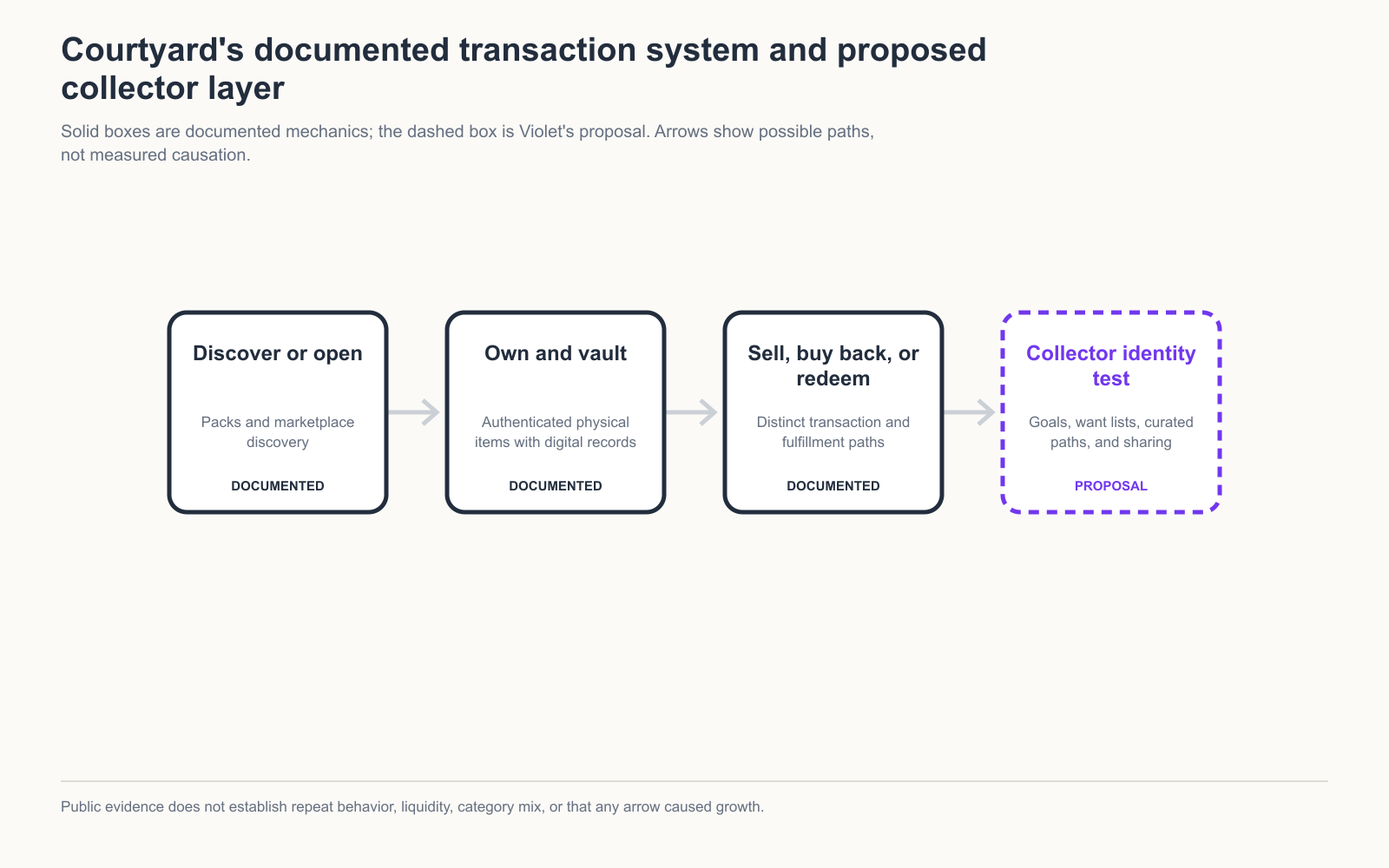
Figure 1. Documented product mechanics and Violet’s proposed testable extension. The proposal is visually separated from company-reported mechanics, and the arrows do not establish causation.
The strongest alternative explanation is simple: a well-designed transaction system can still serve mostly one-off purchases. Public documentation does not say how frequently people open packs, list, buy back, redeem, or return. That gap is why the analysis stops at the mechanism rather than converting product availability into retention.
What do the reported scale numbers establish?
Courtyard reported monthly GMV endpoints of $50,000 and $50 million, but the public sources do not provide compatible endpoint dates and definitions needed to calculate a growth rate. The numbers appear in Courtyard’s funding announcement and Fortune’s July 24, 2025 coverage; they remain company-reported monthly GMV labels rather than an audited series.
That distinction blocks the tempting calculation. The available sources do not align endpoint dates, included transaction flows, refunds, buybacks, or audit status. A large difference between two labels can reflect real scale, a longer interval, or a changed definition. Publishing a percentage would add precision the public evidence does not contain.
The defensible result is still useful: Courtyard publicly reported a material change in monthly transaction value. It is evidence of a scale narrative, but not a measure of user growth, retention, revenue, contribution margin, or the causal effect of packs, marketplace liquidity, vaulting, or redemption.
What does category expansion show?
Courtyard publicly announced coins on June 10, 2026 and its first memorabilia drop on July 8, 2026; those dates establish availability, not adoption or category share. The chronology comes from the coins launch and memorabilia announcement.
Those launches widen the set of collector identities the product could serve. A person who arrives for cards may also care about coins or memorabilia, and a multi-category system creates a plausible reason to expose goals, want lists, milestones, or curated collection paths. That is a product hypothesis, not an observed cross-category behavior.
No complete public sales-mix or category-adoption dataset was available at the study cutoff. The launches may represent meaningful expansion, or simply broader merchandising without durable adoption. The correct operating question is therefore whether a collector layer changes behavior across eligible category cohorts, not whether the announcements themselves prove a network effect.
Which outcomes remain outside public view?
Public data reviewed here cannot establish Courtyard’s unique users, retention, category share, marketplace liquidity, compatible GMV series, or unit economics. This is an evidence boundary, not a negative performance judgment, and it is grounded in the reviewed overview, documentation, and asset-management terms.
The public evidence supports treating collector identity as a testable extension to Courtyard’s transaction system, not as a proven missing cause of retention. That inference uses the same overview, documentation, and agreement, but pricing, inventory quality, category selection, fulfillment, or acquisition mix may matter more than identity features.
The distinction matters for strategy. Missing public retention data cannot become zero retention, and the presence of profiles cannot establish that identity is already solved. Courtyard may have private data or roadmap work that answers either question. An external recommendation should define what evidence would change the decision rather than diagnose an unobserved failure.
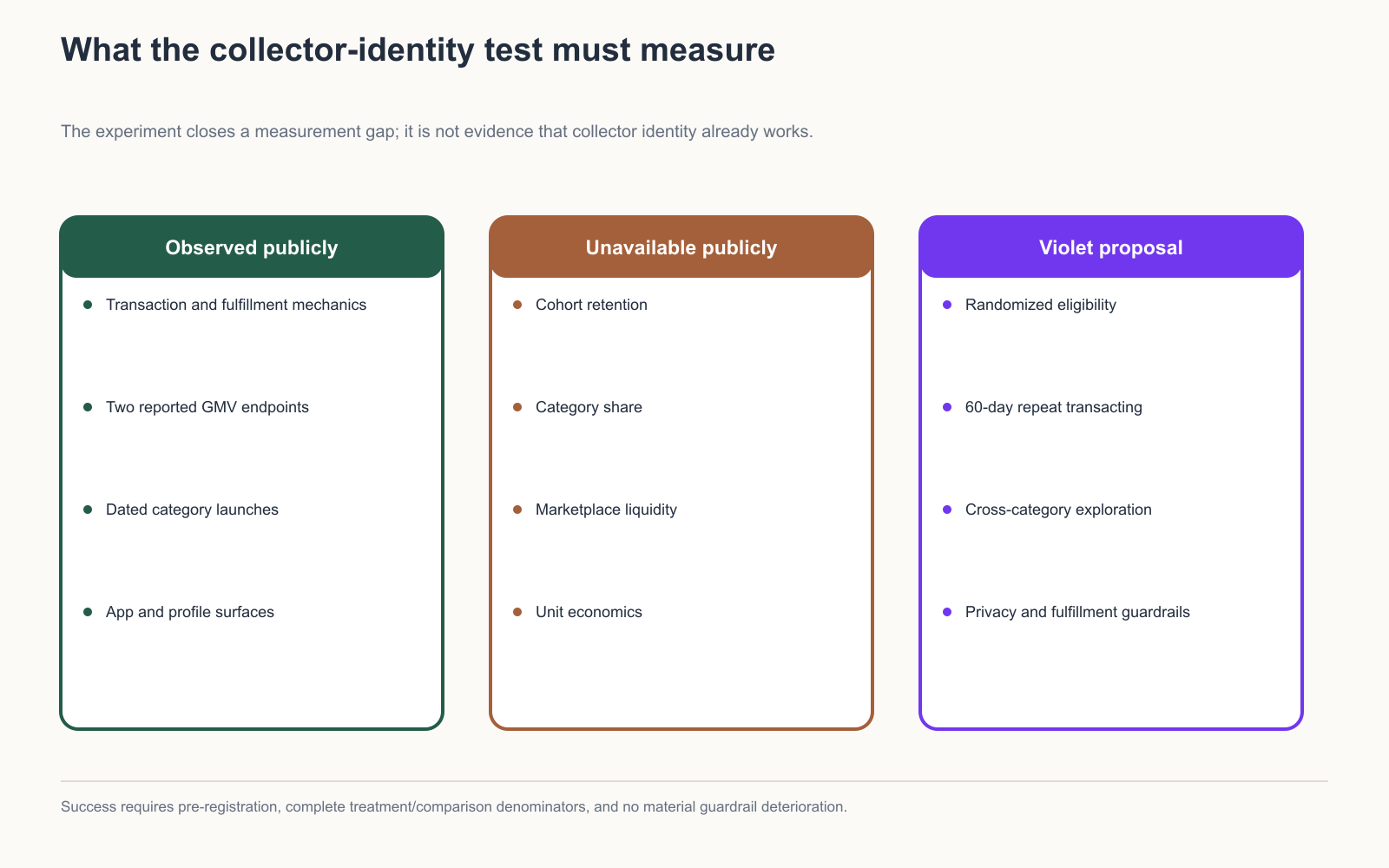
Figure 2. The decision boundary: documented mechanics on the left, unavailable outcomes in the middle, and Violet’s proposed experiment on the right.
How to test the collector-identity hypothesis
Violet proposes an opt-in collector-identity experiment with randomized eligibility, a pre-registered 60-day repeat-transacting measure, and buyback, fulfillment, fraud, complaint, and privacy guardrails. This is Violet’s proposal rather than a Courtyard plan, and its evidence boundary is the public overview, documentation, and asset-management agreement.
Experiment scorecard
| Field | Pre-registered design |
|---|---|
| Label | Violet proposal: test an opt-in collector identity layer |
| Observed constraint | Public surfaces document packs, marketplace sale, buyback, vaulting, profiles, and redemption, but public data cannot establish repeat behavior, category mix, or liquidity. |
| Intervention | Offer an opt-in collector identity experience that lets eligible users publish collection goals and want lists, follow curated collection paths, and share cross-category milestones. |
| Target audience | Eligible new and recently activated collectors |
| Affected partners | Collectors, marketplace sellers, fulfillment operations, and category partners |
| Treatment | Collector identity, goals, want lists, curated paths, and sharing enabled |
| Comparison | Business-as-usual product experience for otherwise eligible users |
| Primary measure | Pre-registered 60-day repeat transacting rate among eligible activated collectors |
| Secondary measures | cross-category exploration rate; qualified marketplace listing rate; collection-goal completion rate |
| Guardrails | buyback reliance; refund and complaint rate; shipping or redemption delays; fraud and privacy incidents |
| Review window | Proposed minimum of 60 days after activation, extended if the pre-registered sample-size calculation is not met |
| Success | A pre-registered statistically and operationally meaningful lift in repeat transacting without guardrail deterioration |
| Revise | Identity engagement rises but repeat transacting does not, or only one category responds |
| Stop | Guardrails deteriorate materially or the feature produces no meaningful identity engagement |
| Scale | Replicate the effect across at least two category cohorts and one later holdout before broad rollout |
Required inputs are random assignment; eligibility timestamp; feature exposure; transaction events; category events; buyback events; redemption events; and support and fraud events. Risks to monitor are privacy exposure; social-pressure or dark-pattern risk; market manipulation; fraud; and category-partner misalignment.
This is Violet’s proposed test. Public evidence does not establish that collector identity causes retention or marketplace liquidity. A different intervention may better address repeat behavior, and effect size, sample size, implementation feasibility, and user response are unknown.
Methods and data boundary
This point-in-time external analysis uses public first-party pages, public documentation, one independent report, and preserved launch announcements qualified through the study’s source registry. Every factual sentence above is copied from an accepted claim ledger and linked to its public source. The two GMV labels remain incompatible; no growth rate was calculated. No marketplace listings were scraped, no authenticated account was used, and no missing private measure was replaced with a proxy.
The observation cutoff is September 17, 2026. Company-reported figures remain attributed as such. Figures are original raster diagrams rendered from canonical analysis JSON; they communicate the evidence boundary rather than add new evidence.
What this analysis cannot establish
This analysis cannot establish whether Courtyard’s users retain, whether category expansion changes behavior, whether the marketplace is liquid, or whether any product mechanic caused the reported scale. It cannot estimate revenue, margin, customer acquisition cost, or unit economics. Private internal evidence could show strong or weak outcomes on all of those dimensions.
It also cannot establish that the proposed identity layer will work. The proposal earns its place because it converts an unresolved strategic idea into a falsifiable decision with a comparison group, a denominator, a time window, and explicit stop conditions.
Bring the market problem into focus.
Turn social and market signals into an ecosystem-growth, go-to-market, or technical engagement built around the work your team needs.
Explore engagements