
Hivemapper Discloses More About Supply Than Demand—What a Public Fulfillment Layer Could Add
What Hivemapper's public supply, token, and customer evidence establishes—and how a bounded work-order pilot could make paid demand more observable.
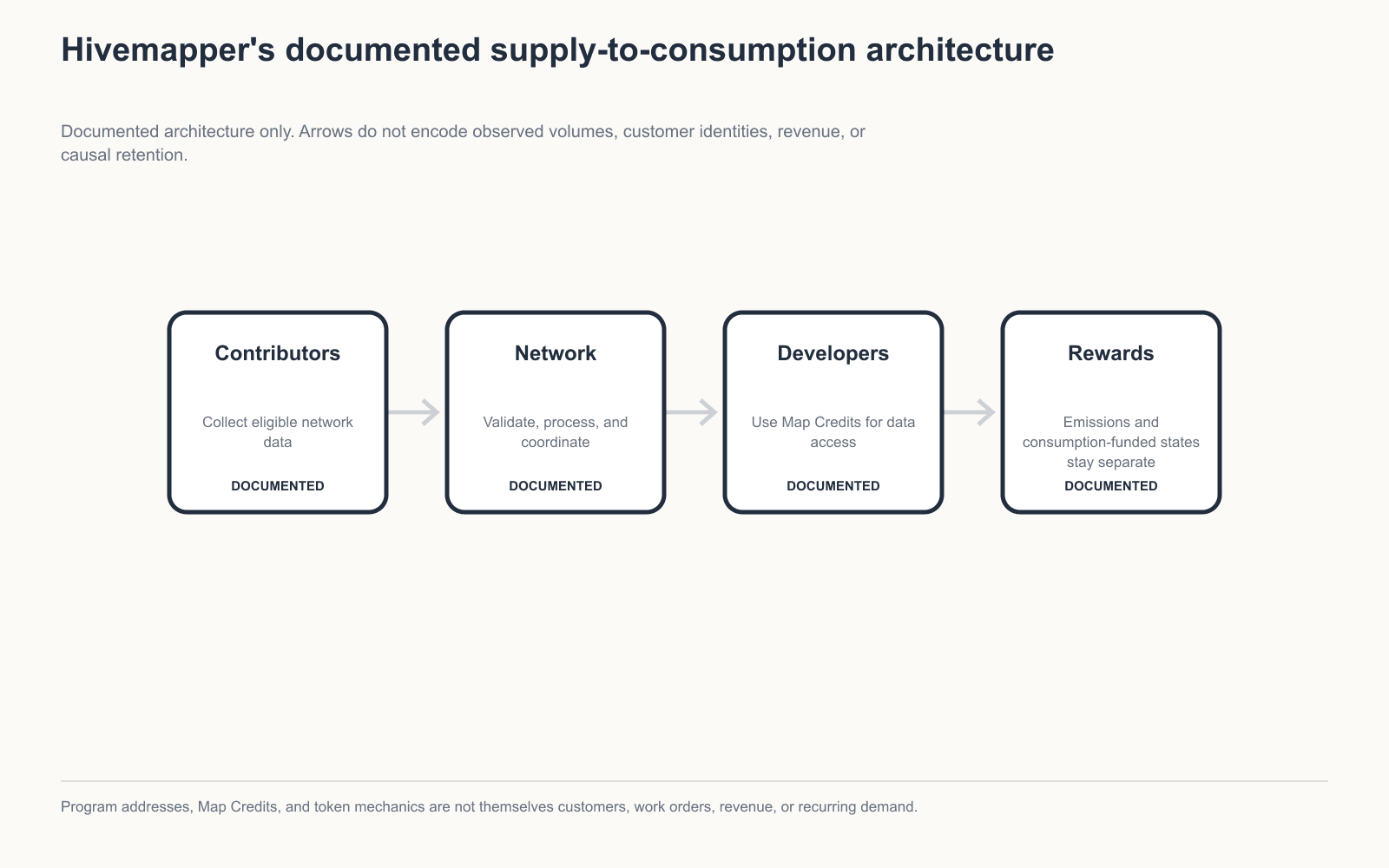
Hivemapper’s public evidence documents its supply architecture, reward and Map Credit mechanics, a dated mapping-scale claim, and one first-party customer case. It does not establish current work-order demand, revenue, customer retention, or causation, so the defensible next step is a measured demand-and-fulfillment pilot rather than a verdict on commercial demand.
The asymmetry is about disclosure, not performance. Public materials make contributors, network roles, tokens, credits, and mapping output easier to inspect than paid work orders, fulfillment, and repeat customer behavior.
A bounded work-order pilot could turn that gap into a test: define corridors and freshness targets, count accepted paid orders, verify fulfillment, and publish privacy-safe aggregate results without pretending token mechanics equal customers or revenue.
At a glance
| Question | Public-data answer |
|---|---|
| What is documented? | Distinct ecosystem roles, contributor mechanics, HONEY rewards, Map Credits, and four labeled Solana programs. |
| What supply evidence is public? | One dated Bee Maps claim of more than 7 million road kilometers per week. |
| What customer evidence is public? | One first-party HERE case reporting a tenfold purchase multiple for 2023 without its absolute baseline. |
| What remains unknown? | Current work orders, fulfillment, active devices, customer roster, revenue, retention, and demand causation. |
| What should be tested? | Paid, predeclared corridor work orders measured through fulfillment, freshness, latency, repeat ordering, cost, concentration, fraud, and privacy. |
Which Hivemapper entity is making each claim?
The public evidence distinguishes the Hivemapper Network, Hivemapper Foundation, Hivemapper Inc., Bee Maps, HONEY, and Map Credits as related but non-interchangeable entities or roles. The crosswalk relies on Hivemapper’s documentation, terms, and driving documentation.
That separation is essential for an external growth analysis. A network reward mechanic is not a Bee Maps customer outcome; a protocol credit price is not Hivemapper Inc. revenue; a contributor action is not a paid work order. Some operational roles may overlap, and public documents may not describe every contractual relationship, but attribution must remain specific.
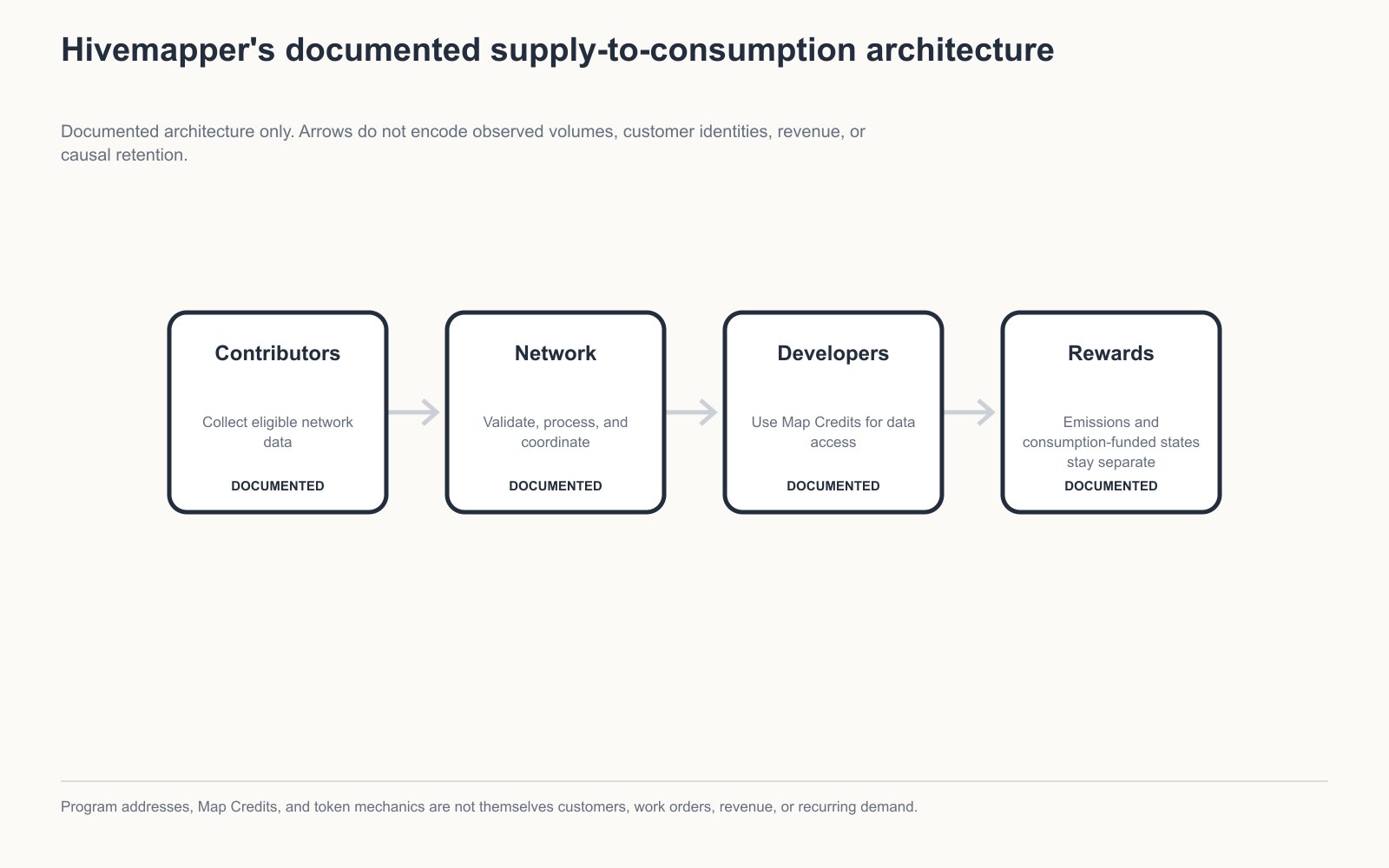
Figure 1. The documented architecture from contribution and mapping supply through network mechanics and customer consumption. Arrows show described relationships, not causal performance.
This framing also keeps the article from treating “Hivemapper” as a single denominator. Supply, reward, customer, and commercial claims can only be compared after their entity, unit, date, and scope match. None of the reviewed observations forms a compatible longitudinal growth series.
Which supply and customer observations are usable?
A July 30, 2024 Bee Maps case study reported more than 7 million road kilometers covered per week and said HERE purchased ten times the amount of Bee Maps data in 2023, but neither row forms a compatible public time series. Both observations come from the same Bee Maps case study and remain first-party reported claims.
The supply label does not separate unique roads from remapping, define geography or freshness, or disclose a device denominator. The purchase multiple does not disclose the absolute quantity or starting baseline. Ten times a small starting amount and ten times a large one describe very different commercial states, and a single customer case cannot establish market-wide demand.
The case is nevertheless useful evidence of a named customer relationship and a dated supply narrative. Its limitation is not that it says nothing; it is that supply kilometers and a purchase multiple are different units. They can inform a pilot design but cannot be divided, trended, or converted into revenue.
What do HONEY and Map Credit mechanics establish?
Hivemapper documentation states a $0.0075 Map Credit price as of May 2025 and labels four Solana programs, but program identities and pricing mechanics do not establish transaction volume, customers, work orders, revenue, or retention. The relevant first-party sources explain HONEY, burn-and-mint mechanics, and reward types.
This is the line between protocol observability and commercial observability. A stated price defines a conversion rule. A program address identifies software. Neither supplies a decoded, complete event ledger tied to accepted customer orders, nor does onchain activity automatically distinguish incentives, transfers, protocol operations, and consumption.
An accepted decoder could make a later chain analysis possible, but it would still need customer and work-order definitions. Counting token activity first and naming it demand afterward would reverse the evidence sequence. The demand unit must be declared before the data is interpreted.
What remains unavailable about paid demand?
The reviewed public data cannot establish current live network aggregates, a compatible supply series, active devices, work-order volume, a complete customer roster, revenue or ARR, retention, or demand causation. That boundary follows from the reviewed documentation, terms, and contributor guidance and must not be read as evidence that demand is absent.
Public disclosure is materially richer for network architecture and mapping supply than for paid-demand fulfillment, but that observability gap is not evidence of weak commercial demand. The inference draws on the same documentation, terms, contributor guidance, the HERE case, and the published HONEY, burn-and-mint, and reward mechanics.
Customer confidentiality or reporting choices could create the same pattern even if demand is strong. Conversely, visible protocol activity could coexist with weak repeat buying. An external analyst cannot choose between those alternatives from the accepted public evidence.
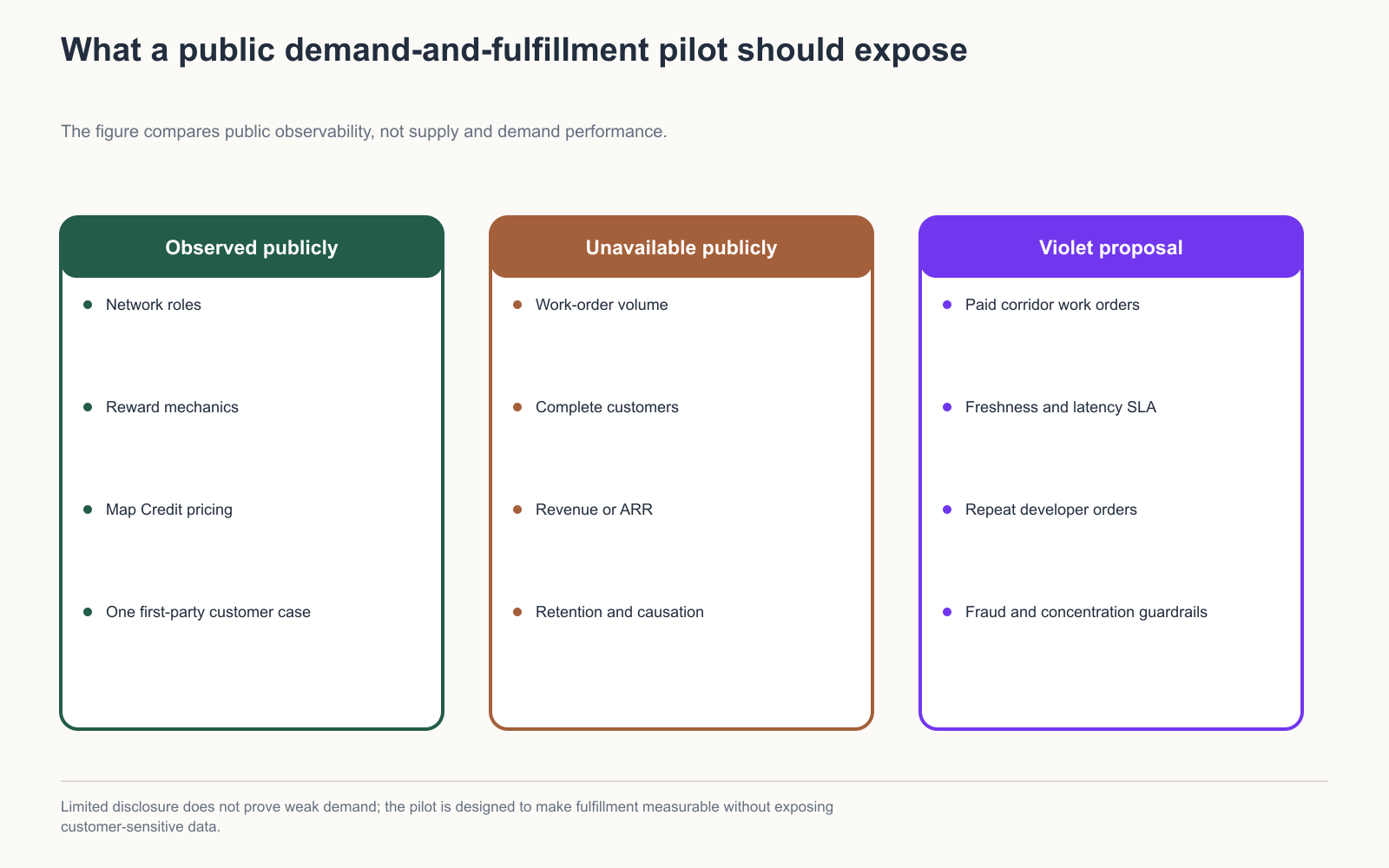
Figure 2. The decision boundary between public supply mechanics, unavailable commercial outcomes, and Violet’s proposed fulfillment pilot.
How to run a demand-and-fulfillment pilot
Violet proposes a bounded paid work-order pilot with predeclared corridors and privacy-safe public reporting of demand, fulfillment, freshness, latency, repeat ordering, contributor concentration, and fraud guardrails. This is Violet’s proposal rather than a Hivemapper plan; the documentation, terms, contributor guidance, and HERE case establish context but not the pilot’s outcome.
Pilot scorecard
| Field | Pre-registered design |
|---|---|
| Label | Violet proposal: pilot a public demand-and-fulfillment layer |
| Observed constraint | Public sources describe supply, rewards, Map Credits, pricing, and one customer case, but not a complete current view of work orders, identifiable customers, fulfillment, repeat demand, revenue, or retention. |
| Intervention | Run a bounded paid work-order pilot in predeclared corridors and publish privacy-safe aggregate demand, fulfillment, freshness, latency, and repeat-order measures. |
| Target audience | Qualified map-data developers with corridor-specific freshness needs |
| Affected partners | Developers, contributors, the Foundation, Bee Maps, and affected road users |
| Treatment | Visible paid work orders with defined corridor, workload, freshness target, deadline, and aggregate public status |
| Comparison | Predeclared matched corridors or eligible periods without visible work orders |
| Primary measure | Share of accepted paid work orders fulfilled within the pre-registered freshness and latency SLA |
| Secondary measures | repeat developer order rate; median verified fulfillment latency; cost per accepted fresh road kilometer |
| Guardrails | duplicate or low-value remapping; contributor concentration; fraud rejection rate; privacy and sensitive-location incidents |
| Review window | Proposed minimum of two complete order-and-remap cycles, extended to meet the pre-registered order denominator |
| Success | The pilot meets its fulfillment SLA and repeat-order threshold without unacceptable concentration or fraud |
| Revise | Orders fill but freshness or repeat demand misses the target, or only one developer segment participates |
| Stop | The pilot misses its minimum paid-order denominator, violates privacy constraints, or creates unacceptable low-value remapping or fraud |
| Scale | Replicate across multiple corridors, workloads, and developer cohorts before broader rollout |
Required inputs are work-order definition and timestamp; corridor and freshness SLA; developer cohort; Map Credit commitment; assignment or matched comparison; verified fulfillment; latency; repeat order; and contributor cost and fraud flags. Risks are sensitive-location exposure; contributor gaming; geographic inequity; developer confidentiality; and token and market-integrity interpretation.
This is Violet’s proposed pilot. Public disclosure gaps do not prove weak demand, and token burns do not equal customers, work orders, revenue, or retention. Private bilateral demand reporting or a different product layer may create more value than public aggregate reporting, while developer participation, confidentiality, order volume, and fulfillment performance remain unknown.
Methods and data boundary
This point-in-time external analysis uses accepted first-party documentation, public terms, contribution and token-mechanics pages, and one first-party customer case. It did not scrape the network map, request a paid Bee Maps credential, query chain activity without an accepted decoder, or treat program identities as transactions. Every factual statement maps to an accepted claim ledger.
The observation cutoff is September 17, 2026. All supply and customer values remain attributed to their publisher with their original date and definition limits. The figures are original rasters rendered from canonical analysis JSON and add no new observation.
What this analysis cannot establish
This analysis cannot establish current mapping coverage, active devices, paid work-order volume, a complete customer roster, revenue or ARR, retention, or causal demand. It cannot infer commercial performance from HONEY, Map Credit pricing, program addresses, or token burns.
It also cannot establish that public work orders are the best commercial interface. The pilot is useful because it creates a declared demand unit and a falsifiable fulfillment outcome while preserving privacy and confidentiality. Failure to meet the denominator, SLA, repeat-order threshold, or guardrails is a failed pilot—not a partial success.
Bring the market problem into focus.
Turn social and market signals into an ecosystem-growth, go-to-market, or technical engagement built around the work your team needs.
Explore engagements