
Blackbird's Public Expansion Story—and the Incrementality Test It Still Needs
What Blackbird's public restaurant expansion evidence can support, why its location counts do not form a series, and the incrementality test to run next.
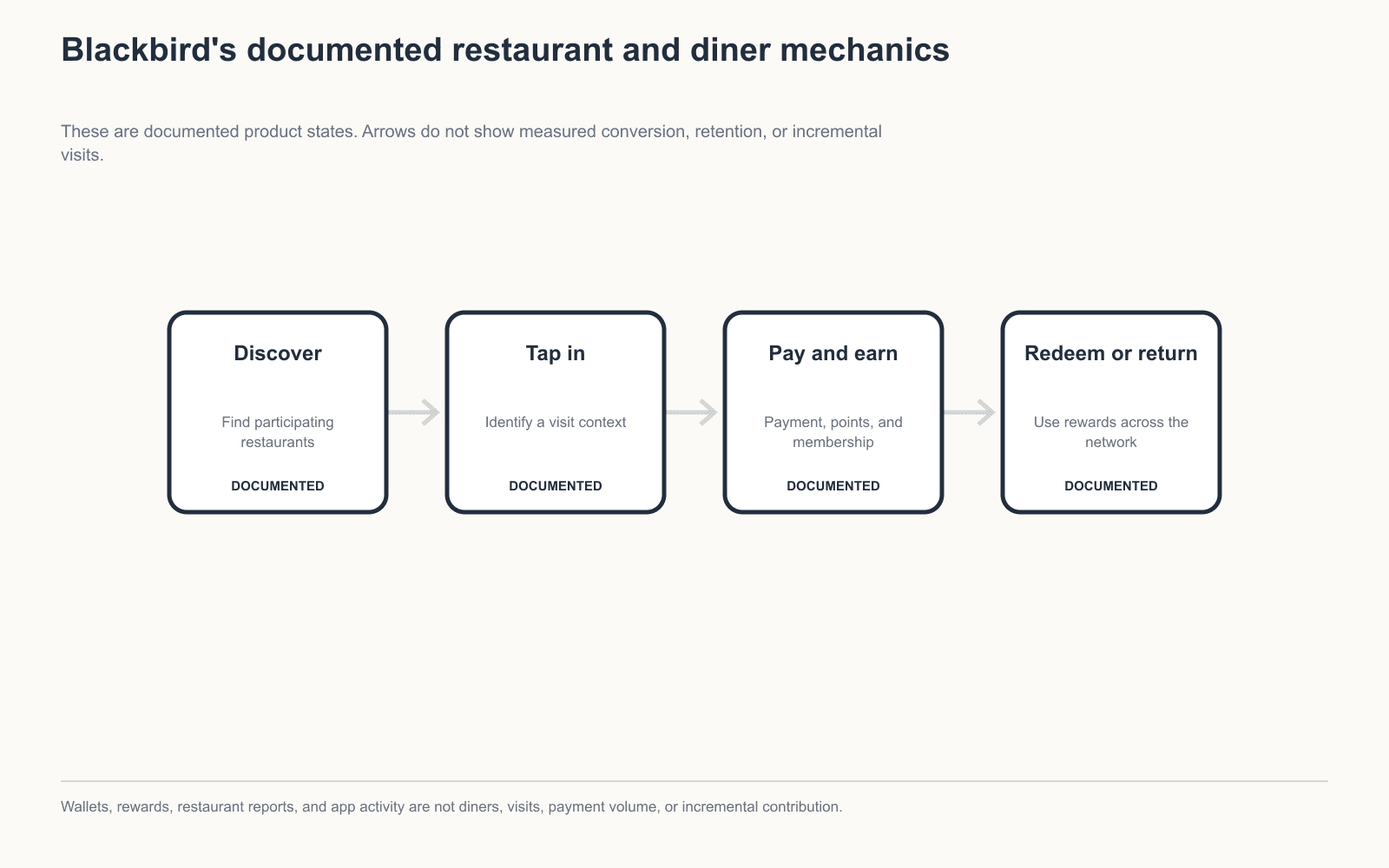
Blackbird’s public evidence documents an integrated restaurant product and reported expansion, but public restaurant counts use incompatible states and cannot establish active density, diner retention, or incremental contribution. The next useful proof is a restaurant-level counterfactual test, not another top-line location count.
The public story is substantial but narrower than a growth curve. Blackbird has described a path from discovery and tap-in through membership, rewards, payment, redemption, and Flynet concepts; public reports also describe multiple restaurant states at different dates.
What those sources do not provide is the counterfactual: how many visits or how much restaurant contribution occurred because of the treatment. A pre-registered holdout design would make the growth claim decision-grade.
At a glance
| Question | Public-data answer |
|---|---|
| What is documented? | A restaurant and diner flow spanning discovery, tap-in, membership, rewards, payment, redemption, and settlement concepts. |
| Do location counts form a series? | No. Relationships, live venues, network coverage, and signed-up restaurants are different states. |
| Is local density measured? | No complete dated public directory supports a density calculation. |
| What remains unknown? | Active restaurants, diners, retention, incremental visits, payment volume, and restaurant contribution. |
| What should be tested? | Restaurant-level randomization or a pre-registered matched holdout with incremental contribution as the primary outcome. |
Which product and payment mechanics are documented?
Blackbird publicly documents a product flow spanning discovery, tap-in, membership, rewards, payment, redemption, and Flynet settlement concepts. The supporting materials are Blackbird’s public site, the Flypaper, and Flynet documentation; planned or future Flypaper mechanisms are not assumed to be live.
That flow connects a diner’s restaurant experience to identity, loyalty, and payment. It also gives participating restaurants several possible levers: recognizing a diner, issuing or redeeming value, reducing payment friction, and learning whether a person returns. Public documentation establishes that those components are described, not how often they are used or whether they add visits.
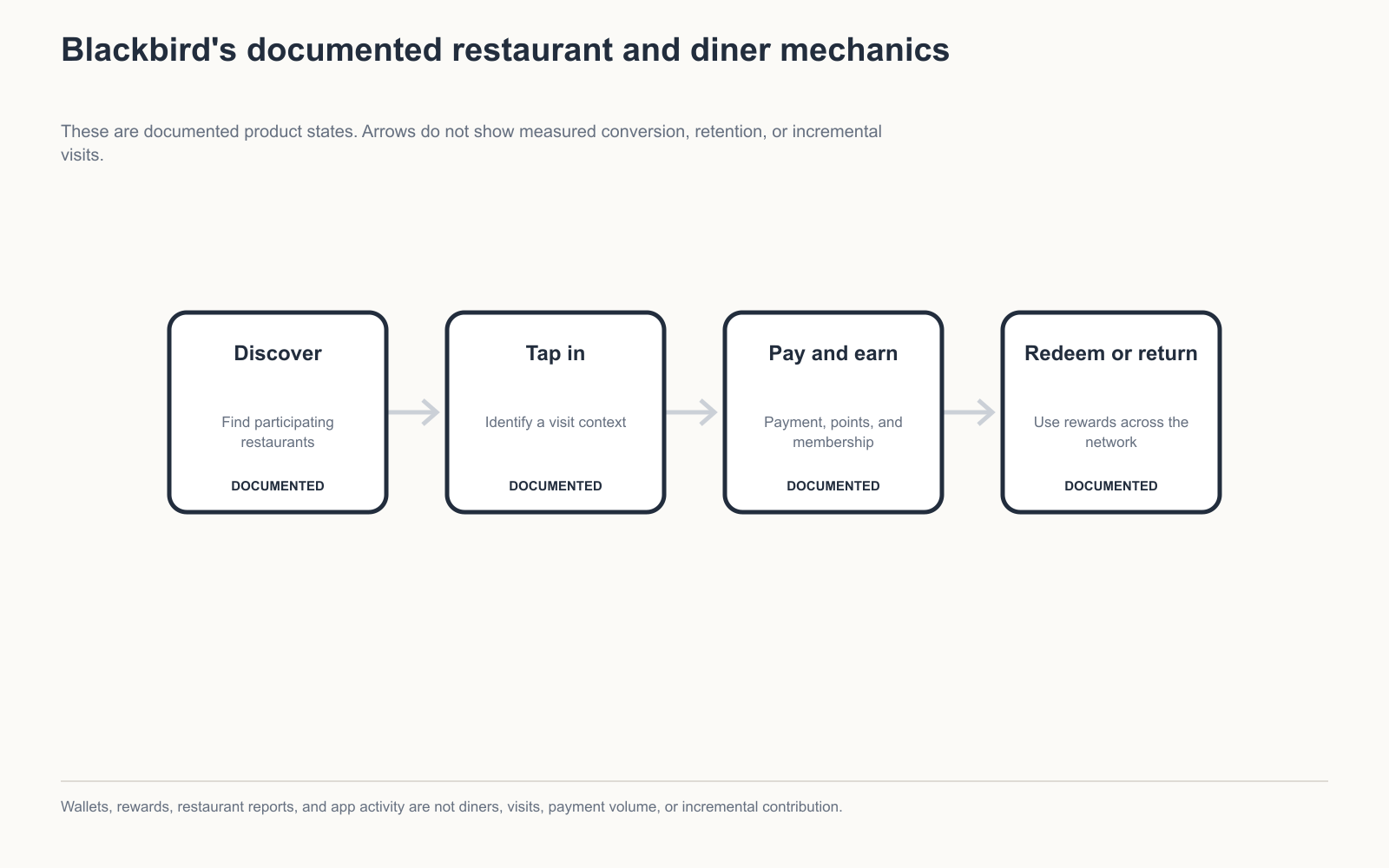
Figure 1. Blackbird’s documented restaurant and diner mechanics. The sequence is architectural and does not claim that any step caused expansion or incremental demand.
The alternative explanation is that the product facilitates demand that would already have occurred. A smooth tap-in or reward path may improve experience without changing restaurant contribution, while restaurant quality, geography, promotions, and diner composition can independently move the same outcome. That is why an expansion count cannot answer the central economic question.
Why the restaurant counts do not form a growth series
Two reports published on April 8, 2025 described more than 600 restaurants that the network encompassed and some 1,000 restaurants signed up; those states are not definitionally comparable and do not form a growth series. The labels come from separate same-day reports by Fortune and Yahoo Finance, neither of which supplies a complete current directory or a common active-state definition.
Blackbird’s October 4, 2023 release reported relationships with over 80 restaurants and 22 already live, preserving relationship-reported and live as separate states. That company announcement is a dated snapshot, and subsequent activity and completeness are not public.
The four numbers describe at least four possible units: relationships, live venues, restaurants encompassed, and restaurants signed up. Joining them would silently treat onboarding states as equivalent. The evidence supports a chronology of reported expansion, not a calculated restaurant-growth rate or a claim about how many venues were active at the study cutoff.
What can the public record say about local density?
Two reports published on April 8, 2025 described more than 600 restaurants that the network encompassed and some 1,000 restaurants signed up; those states are not definitionally comparable and do not form a growth series. Local restaurant density is a reasonable operating hypothesis for Blackbird, but the public evidence is too incomplete to measure density or attribute demand to it. The April 2025 Fortune report and Yahoo Finance report support the existence of expansion claims, not a complete venue-by-market denominator.
Density could matter because a diner who encounters the product at several relevant restaurants may learn the system faster and find more opportunities to use membership or rewards. But a smaller network of high-fit restaurants could outperform a denser network. Restaurant quality, diner mix, reward economics, payments, and market operations may matter more than raw venue count.
The practical consequence is to stop treating location count as the outcome. Market selection can remain part of experiment stratification, but the score should be incremental contribution at eligible restaurants. Density is then a possible moderator to estimate after the primary decision, not a substitute for it.
Which diner and restaurant outcomes remain unavailable?
The reviewed public data cannot establish a complete live directory, active restaurants, diners, retention, incremental visits, payment volume, unit economics, or review-topic prevalence. That boundary follows from the reviewed Blackbird site, Flypaper, and Flynet documentation and does not mean any of those outcomes are zero.
Public check-ins, rewards, wallets, downloads, and restaurant testimonials would still be poor replacements for a counterfactual. Each can move when the product is used, but none says what would have happened without the treatment. Blackbird and its restaurant partners may already possess private experiments or payment data showing positive, negative, or heterogeneous effects.
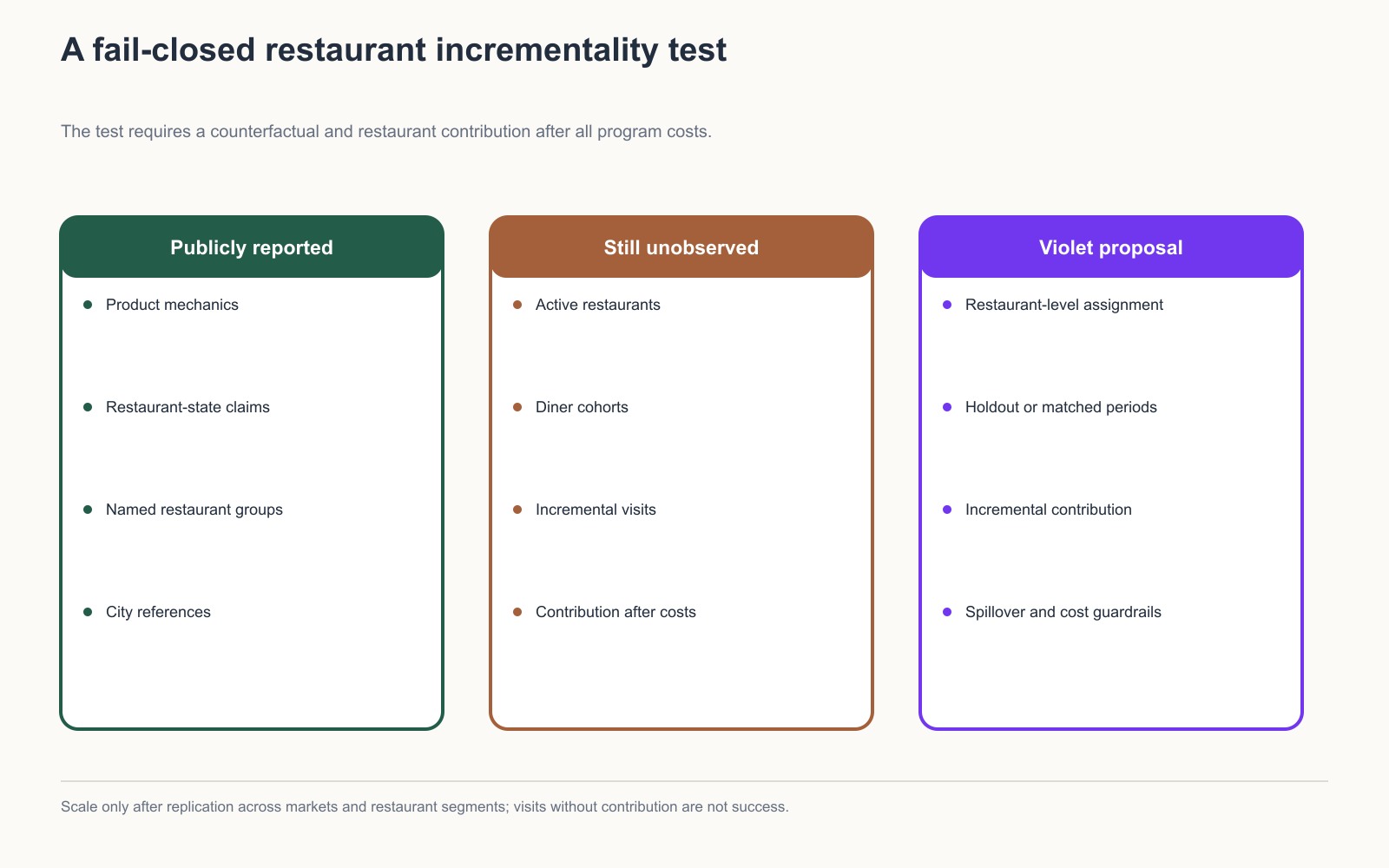
Figure 2. A fail-closed decision model. Documented mechanics and unavailable economic outcomes remain separate from Violet’s proposed test.
The measurement gap should not be phrased as a diagnosis. It is an invitation to define an eligible unit, assignment method, pre-period, outcome window, and cost-complete measure. Only then can the company distinguish attractive product activity from incremental restaurant value.
How to test restaurant-level incrementality
Violet proposes a pre-registered restaurant-level randomized or matched holdout test whose primary measure is incremental restaurant contribution after reward, payment, and program costs. This is Violet’s proposal rather than a Blackbird plan; the public site, Flypaper, and Flynet documentation establish the product context but not an incremental effect.
Experiment scorecard
| Field | Pre-registered design |
|---|---|
| Label | Violet proposal: test restaurant-level incrementality |
| Observed constraint | Public reports use incompatible restaurant states and do not disclose active locations, diner cohorts, counterfactual visits, payment volume, or restaurant contribution. |
| Intervention | Run a pre-registered restaurant-level randomized or matched holdout test of a defined Blackbird demand treatment in selected local markets. |
| Target audience | Eligible diners around participating restaurants |
| Affected partners | Participating restaurants, restaurant staff, diners, and payment/reward partners |
| Treatment | A fixed Blackbird acquisition and repeat-visit treatment with pre-registered reward economics |
| Comparison | Eligible holdout restaurants or matched restaurant-periods without the treatment |
| Primary measure | Incremental restaurant contribution after reward, payment, and program costs |
| Secondary measures | incremental verified visits; new-to-restaurant diner rate; repeat visit rate within the review window |
| Guardrails | restaurant operational burden; reward cost per incremental visit; refund and dispute rate; diner complaint rate |
| Review window | Proposed minimum of two complete local demand cycles plus the pre-registered repeat-visit window |
| Success | Positive incremental contribution with confidence bounds above the pre-registered minimum and acceptable guardrails |
| Revise | Visits lift but contribution does not, or effects concentrate in a narrow restaurant segment |
| Stop | Contribution is negative beyond the stop boundary or restaurant/diner guardrails deteriorate materially |
| Scale | Replicate across at least two markets and multiple restaurant segments before network-wide use |
Required inputs are restaurant eligibility and assignment; pre-period visits and contribution; treatment exposure; verified visits; check contribution after discounts and fees; reward cost; and refunds and complaints. Risks are restaurant spillovers; selection bias; reward arbitrage; consumer disclosure; and payment and loyalty regulation.
This is Violet’s proposed experiment. Public check-ins, wallets, rewards, downloads, or restaurant reports do not establish incremental visits or contribution. Observed changes could still come from restaurant mix, seasonality, promotions, or market-level demand, and assignment feasibility, spillovers, sample size, and effect size remain unknown.
Methods and data boundary
This external analysis uses public first-party product materials, the complete public Flypaper text, public Flynet documentation, a dated company release, and two same-day independent reports. Every factual sentence maps to an accepted claim ledger. Restaurant-state labels remain separate, no current directory was fabricated, and no account, private API, payment flow, wallet action, or undocumented endpoint was used.
The observation cutoff is September 17, 2026. Company and publisher labels are attributed rather than independently verified. The diagrams are original rasters rendered from canonical analysis JSON and add no new performance evidence.
What this analysis cannot establish
This analysis cannot establish Blackbird’s current active restaurant count, diner base, retention, payment volume, restaurant contribution, or unit economics. It cannot determine whether restaurant density, rewards, payments, brand selection, or local operations caused reported expansion.
It also cannot promise that the proposed treatment will be incremental. The value of the design is that a negative, mixed, or positive result remains interpretable: the primary measure includes program costs, the comparison supplies the missing counterfactual, and explicit revise, stop, and scale rules prevent activity from being mistaken for success.
Bring the market problem into focus.
Turn social and market signals into an ecosystem-growth, go-to-market, or technical engagement built around the work your team needs.
Explore engagements