
How to Run ChatGPT Ads Effectively, and What the $1,200 Burn Post Got Wrong
A ~1% CTR is the industry benchmark, not a verdict. What the widely cited $1,200 ChatGPT Ads experiment actually measured—and how to instrument a test properly.
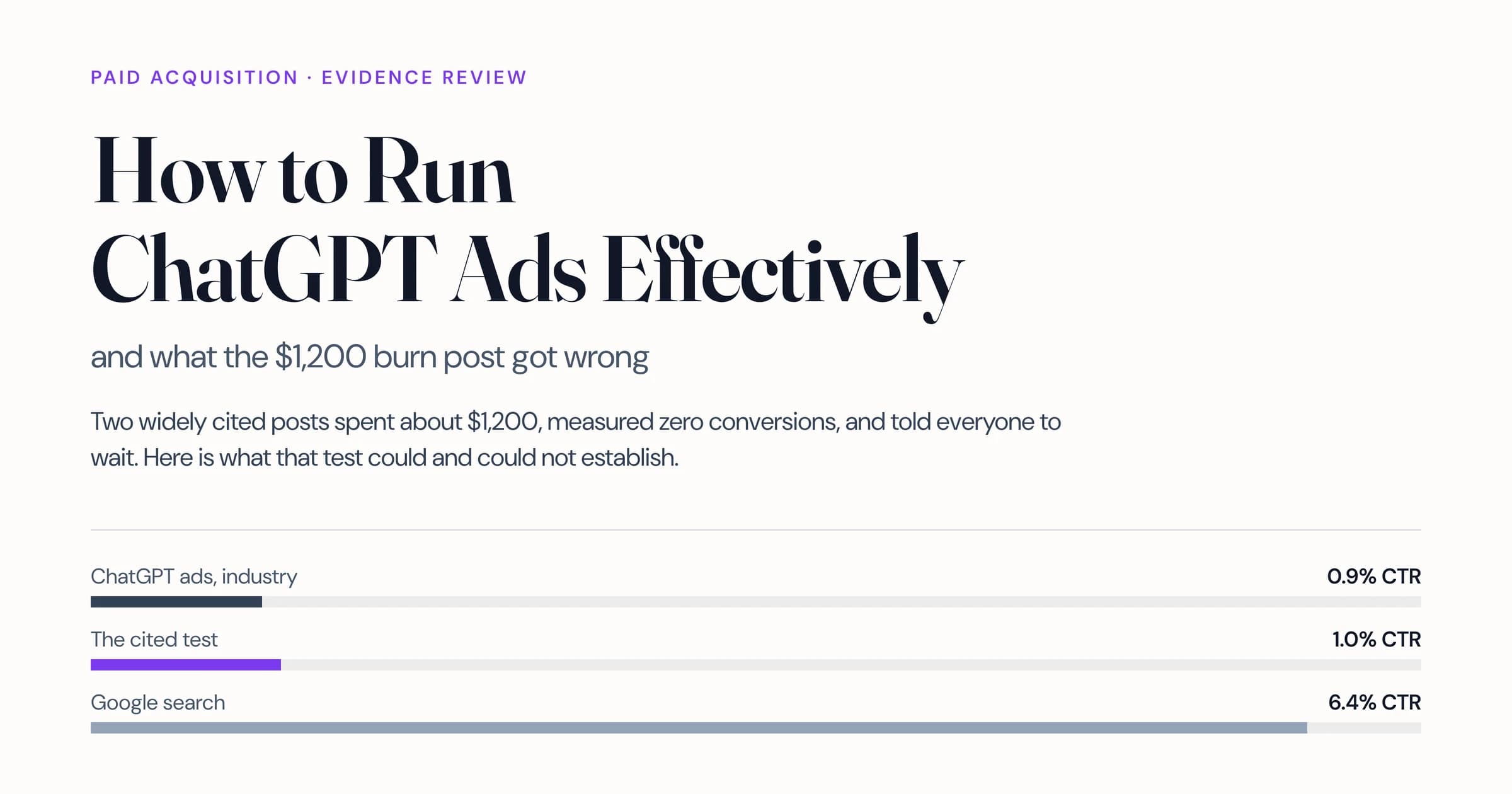
If you searched for how to run ChatGPT Ads, you almost certainly found the same two write-ups. The first, from the Google Ads agency Grow My Ads, reports roughly $1,200 in spend, 92 clicks, an average CPC of $13, an average CPM of $120, a click-through rate near 1%, and zero conversions, then recommends that most advertisers wait and treat the channel as “mostly a burn-budget experiment”. The second, on DailyTopAI, carries the same numbers with the same conclusion. We could not find the “$1,000 on ChatGPT Ads is like lighting money on fire” article those posts are remembered as. We are not going to argue with a sentence nobody wrote, but we will argue with the conclusion both posts do make.
The numbers are not the problem. The experiment reported its own data honestly, and the failure it describes is real. The problem is that four of its conclusions do not follow from that data. A ~1% click-through rate is roughly the industry average for this surface, not evidence of a broken auction. A $3 bid is a recommended starting point, not a price floor. A nearly empty ad manager is missing attribution, not missing performance. And an audience restricted to Free and Go users is a fit question for consumer and DTC advertisers, not a universal disqualifier.
None of this makes ChatGPT Ads a proven channel, and no credible ad-side conversion benchmark is public. The case here is narrower: you cannot conclude the channel failed from a test that broke its own attribution. We can also show what the alternative looks like, because we ran it—a small instrumented campaign on the same surface, reported in full below.
At a glance
- The cited experiment is real and small. One advertiser, one market, roughly two weeks, about $1,200, 92 clicks. A single case, not a benchmark.
- Its ~1% CTR is the benchmark, not a failure. The dated industry figure for ChatGPT ad CTR is about 0.9% (eMarketer 2026, as compiled by Tru Commerce). The ~6.4% it gets compared against is Google search, a different placement.
- $3 is a recommended starting bid, not a floor. Reported ranges run $3–$5 per click for consumer categories and $8–$18 for software and finance. The $13 the test settled at sits inside the software band.
- The empty-looking ad manager measured the wrong layer. Beta reporting is thin and lagged, and the test’s own UTM bug broke its GA4 attribution. A zero measured through a broken pipe is a measurement result.
- Low CTR is not a verdict. Our own 17-day ChatGPT Ads campaign ran at 0.60% click-through—below the ~0.9% benchmark—and still returned 26 conversions at $57.42 each and 2.67x blended ROAS.
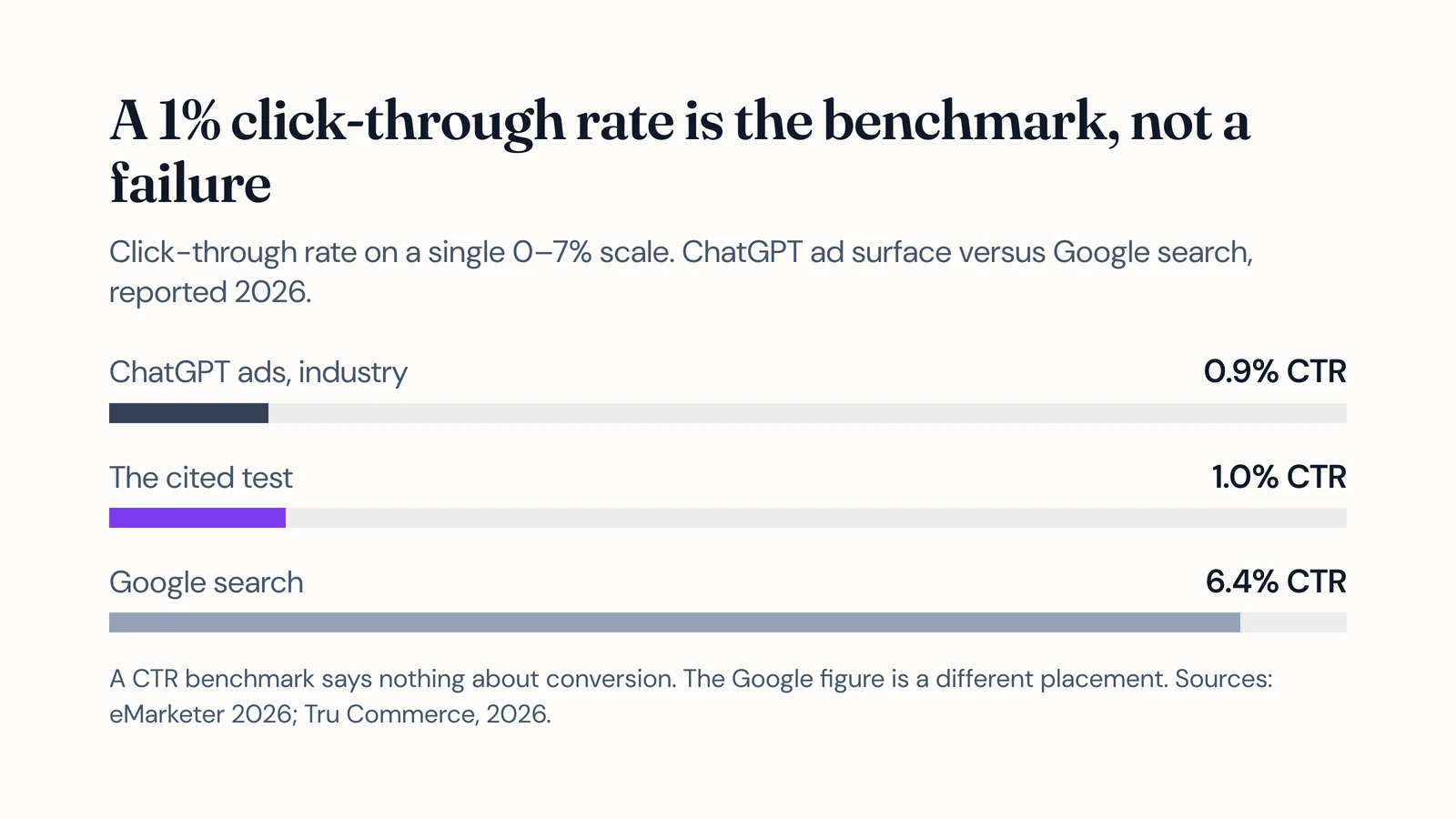
Figure 1. ChatGPT ad CTR against the two numbers it gets measured by. The ~1% result in the cited test sits just above the ~0.9% industry benchmark for this surface; the ~6.4% comparison is Google search, a different placement. Sources: eMarketer 2026 and Tru Commerce benchmarks, both dated August 2026. What this cannot establish: a CTR benchmark says nothing about conversion or revenue.
What the experiment actually measured
Before rebutting a result, name its shape. The cited experiment is one advertiser, one market, one objective, about two weeks. Its unit is a click; its denominator is the impressions OpenAI served; its outcome field is a single conversion event on a page whose analytics had broken.
That last detail matters most. The post reports that “a UTM tracking bug” caused “the ad [to break] … broke our GA4 attribution. ChatGPT traffic was showing up as direct in Google Analytics.” A broken conversion instrument does not measure demand, and the post’s own recommendation to wait rests on a number it tells you not to trust.
| Field | Cited experiment | What it can support |
|---|---|---|
| Spend | ~$1,200 over ~2 weeks | Order-of-magnitude budget sizing |
| Clicks | 92 | A small-sample CTR estimate |
| CTR | ~1% | Comparison to a like-for-like benchmark |
| Avg CPC | ~$13 | Comparison to category cost ranges |
| Avg CPM | ~$120 | Comparison to reported CPM ranges |
| Conversions | 0 | Nothing, because attribution was broken |
| Breakdowns | None by query, theme, or placement | Nothing about match quality |
This is the missing-state problem in miniature: “we could not measure it” and “we measured zero” are different states, and the post collapses them into a verdict on the channel.
Is a 1% click-through rate proof that the channel is broken?
No. It is close to the published benchmark. The dated industry figure for ChatGPT ad CTR is about 0.9%, and the compiler reports its own US campaigns averaging about 1.3% since July 2026. A vendor creative sample put product ads in a 4–7% band; treat the ~0.9% as the bar.
The comparison that makes 1% look catastrophic is ~6.4%, the CTR for Google search ads. That is a real number, but not the same unit: a Google results page can carry several competing text ads, while a ChatGPT answer carries one ad below the response, matched to the conversation rather than a typed query. The same benchmark calls the gap “a different unit in a different context, not a worse one,” and the honest question is not “is CTR above 6.4%?” but “does the traffic convert, and at what cost?”
The most-quoted conversion number in this debate—that ChatGPT-referred ecommerce traffic converts at 15.9% against 1.76% for Google organic—is Adobe’s 2025 referral data. It is organic referral, not an ad-click rate; using it to defend ad performance repeats the category error of using 6.4% to attack it. No credible ad-side conversion benchmark is public.
Is there a $3 CPC floor?
No. $3 is a starting recommendation, not a wall. The cited post raised its max CPC until the interface flipped from “May not deliver” to “Strong delivery,” then settled near $13 and framed that as a floor. But the interface labels bid strength, not a market minimum. OpenAI recommends starting max CPCs around $3–$5, and third-party ranges put consumer categories at $3–$5 and software and finance at $8–$18. The $13 average is the middle of the software and finance band; the ~$120 CPM is above the reported range, suggesting the test over-paid.
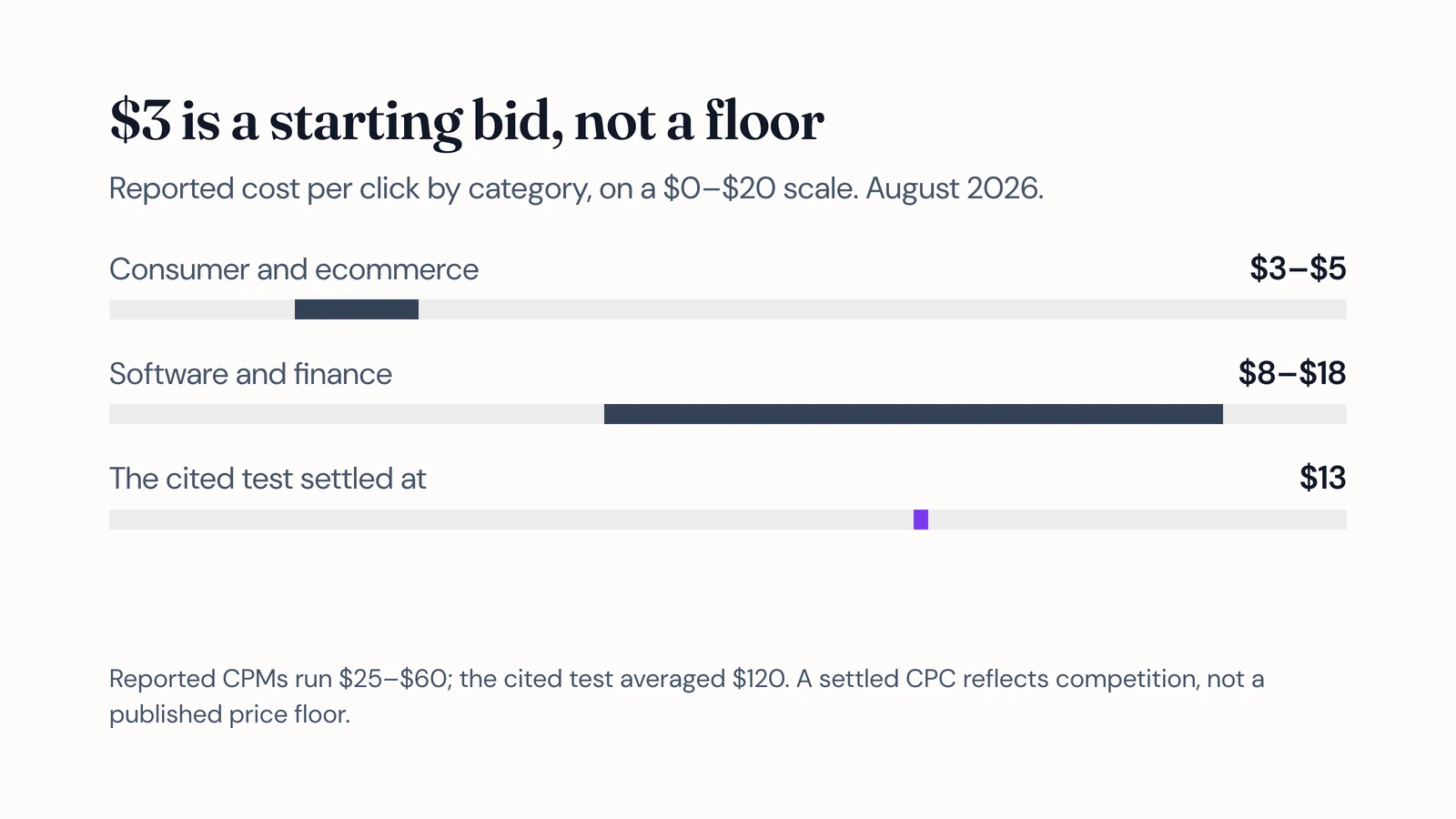
Figure 2. Reported cost ranges by category against the cited test’s settled average CPC. The $13 average sits inside the $8–$18 software and finance range, not above a ceiling. Sources: WebFX and Tru Commerce benchmarks, August 2026. What this cannot establish: a CPC band says nothing about whether the traffic converts.
The mechanism matters more than the number. Bidding runs through a relevance-weighted second-price auction with two modes—Maximize results or a manual max CPC—plus a conversion-optimized CPC option billed per valid click. The price you pay is set by the competition you beat and the relevance you earn, not a fixed floor. That is why the same $3 bid can read “Strong delivery” for one advertiser and “May not deliver” for another: the “floor” framing reads the interface as a price list rather than a signal.
Why did the ad manager look empty, and what does that prove?
The manager looked empty because the beta reports little: impressions, clicks, spend, CTR, average CPC, average CPM, and conversions, with a lag on spend—a displayed zero does not mean nothing was charged. What it does not expose is the layer a performance marketer needs: results by query, theme, audience, or placement. Those omissions are a reporting limitation, not a performance result. “The dashboard does not tell me why” is a different sentence from “the channel does not work.”
The measurement gap is where a competent advertiser should spend effort. OpenAI documents a measurement pixel and a conversions API and preserves static UTM parameters for Google Analytics; instrument before spending, deduplicated on a shared event ID, because much ChatGPT traffic otherwise lands as Direct. The cited experiment hit exactly that: its UTM broke, and it could not distinguish “the traffic did not convert” from “we did not see the traffic.”
Do ChatGPT Ads only reaching Free users make them useless?
For B2B software, mostly yes—stated plainly by the platform, not discovered by critics. Ads appear only to logged-in adults on the Free and Go tiers; Plus, Pro, Business, Enterprise, and Education users never see them. The cited post is right that a B2B advertiser here pays to reach an audience without the seat-holders it wants.
But “not for B2B” is not “not for anyone.” The compiled research finds roughly one in ten conversations carries commercial intent, and that in 12 of 14 industries the market leader ran zero ChatGPT ads; intermediaries, comparison sites, and affiliates held the slots. Incumbents already win the organic recommendation, the only layer paid-tier users see, so they have little reason to rent the slot beneath it. Challengers do.
What actually decides whether your ad gets matched?
Context hints and creative specificity, in that order. Advertisers do not bid on exact-match keywords but on ad-group-level context hints: descriptions of the conversations where they want to appear. OpenAI is explicit that hints do not guarantee delivery in specific conversations, so the cited post’s line—that anyone claiming to have cracked the context-hint formula is guessing—is closer to correct than its other conclusions. It is not a formula but a live-auction relevance signal.
The reproducible finding is about creative, not hints. In Criteo’s published sample, impressions varied roughly fourfold between scenario-specific creatives and generic ones, while every creative’s CTR stayed inside the same 4–7% band—specificity changed how often the ad matched, barely how often it was clicked. In a system that matches conversations rather than keywords, the creative and the hint decide how much of the auction you qualify for. Thin impression volume in the first two weeks is usually a matching problem, fixed by editing the inputs rather than raising the bid.
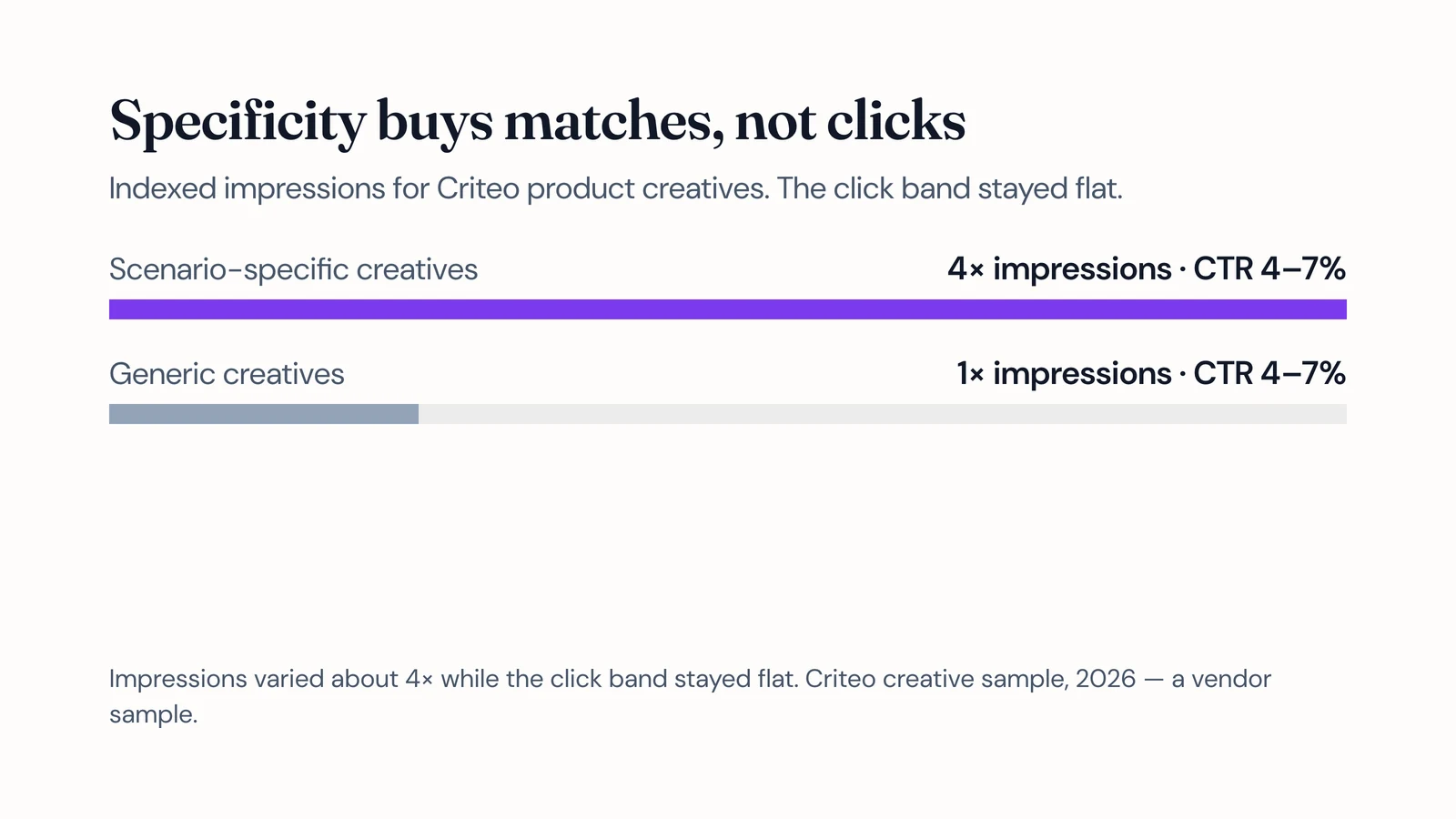
Figure 3. Creative specificity against match frequency and click rate, from Criteo’s published sample of about 3,850 product-ad displays. Specificity moved how often the creative matched; the click band barely moved. Source: Criteo via Tru Commerce, September 2026. This is a vendor sample, not an account-level benchmark, and it cannot establish conversion differences between creatives.
What our own ~$1,500 test actually looked like
Violet sells an AI storyboard tool, and we wanted to know whether Etsy sellers discover a product like that inside ChatGPT. Over seventeen days we ran a small conversion campaign—two ad groups, five creatives, both placements, US, Canada, and the UK—with conversion tracking configured before the first dollar moved.
| Window | Spend | CTR | CPC | Conversions | Cost per conversion | ROAS |
|---|---|---|---|---|---|---|
| Days 1–8 (Aug 20–27) | $684.00 | 0.52% | $3.32 | 6 | $114.00 | 1.26x |
| Days 9–17 (Aug 28–Sep 5) | $809.00 | 0.67% | $2.61 | 20 | $40.45 | 3.86x |
| Full flight | $1,493.00 | 0.60% | $2.89 | 26 | $57.42 | 2.67x |
Table 1. Violet — Etsy Q4 Video Launch, ChatGPT Ads, 34 exported rows (two ad groups × 17 days), 86,100 impressions and 516 clicks. Attributed revenue $3,980.00. Source: our own campaign export, flight August 20–September 5, 2026.
The comparison is the point. For about the same money over a similar window, we ran a click-through rate below the ~0.9% benchmark yet returned 26 conversions, a $57.42 cost per access request, and 2.67x blended ROAS. That does not make the channel proven, but it shows a 0.60% CTR attached to a working funnel looks nothing like a burn—and that the gap between our result and the cited one is instrumentation, not luck.
The two phases also reproduce the ramp the benchmark material describes: cost per conversion fell 64.5%, from $114.00 to $40.45, and CPC from $3.32 to $2.61. The team’s account is that it rewrote the hooks around trends sellers recognize; the export carries the same five creatives in both phases, so the data cannot settle whether the creative or the delivery curve did the work.
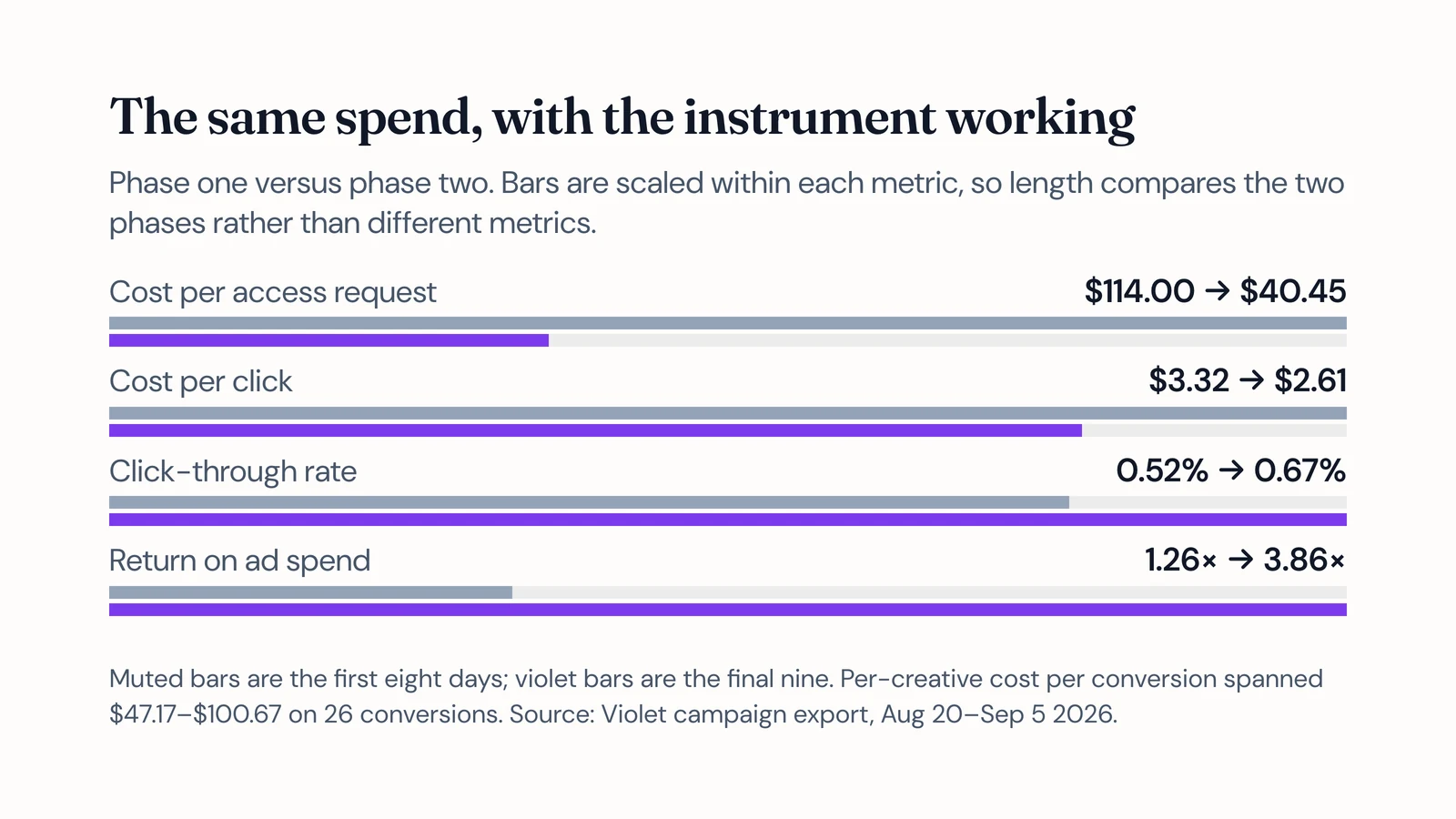
Figure 4. Phase one versus phase two of our own campaign, on shared scales. Cost per conversion and CPC fell while CTR and ROAS rose, consistent with the slow beta delivery ramp. Source: Violet — Etsy Q4 Video Launch, 34 exported rows, August 20–September 5, 2026. This is one small campaign with 26 conversions; it is a signal, not a settled cost per acquisition.
The limits matter as much as the numbers. Across five creatives, cost per conversion ranged from $47.17 to $100.67—far too wide to rank creatives on 26 conversions. Placement was neutral (answer card $57.62 versus product card $57.23), and region ran US $60.31, Canada $51.20, UK $54.40. This is one niche campaign, one flight, one budget, with attributed rather than verified revenue.
How to run the test the cited experiment did not run
The practical version costs less than $1,200. Instrument first: measurement pixel plus a server-side conversions API, deduplicated on a shared event ID. Land the click on a page that answers the conversation’s actual question, not a homepage. Write context hints as decision moments (“someone choosing a business bank account with no monthly fee”) rather than topics (“banking”), and give each ad group a generic control. Judge CTR against the ~0.9% surface benchmark, not the ~6.4% Google number. Expect the first two weeks to look worse than the first two months. Write down your stop condition before you spend: a funnel that cannot distinguish zero conversions from unmeasured ones will always produce a zero.
That sequence produces a real answer either way, and it is the honest version of “wait”: decide from an instrument that works — the discipline behind our paid growth work — because a follower count is not a growth strategy.
What this does not show
This article cannot tell you that ChatGPT Ads converts, because no credible ad-side conversion benchmark is public. It cannot tell you the cited experiment would have succeeded with better instrumentation—only that its zero is not evidence either way. It cannot generalize one advertiser’s two weeks to your category, and it does not claim the ~0.9% benchmark will hold as delivery matures. Our own campaign is one niche flight with 26 conversions, attributed revenue we did not verify, and no control group; read it as a signal, not a settled cost per acquisition.
Frequently asked questions
Is a 1% click-through rate bad for ChatGPT Ads?
No. The dated industry benchmark is about 0.9%, so a ~1% result is at or slightly above average. The ~6.4% it gets compared against is Google search, a different placement that matches typed queries rather than conversations.
Is there a $3 CPC floor on ChatGPT Ads?
No. $3 is OpenAI’s recommended starting max bid, not a hard minimum. Settled cost per click is set by a relevance-weighted second-price auction; reported ranges run $3–$5 for consumer categories and $8–$18 for software and finance.
Do ChatGPT Ads work for B2B?
Not as a LinkedIn Ads replacement. Ads only reach logged-in adults on the Free and Go tiers; Plus, Pro, Business, Enterprise, and Education seats never see them. That makes it a consumer and DTC demand channel, not a way to reach B2B decision-makers.
Why does the ChatGPT Ads manager show so little?
The beta reports impressions, clicks, spend, CTR, average CPC, and average CPM with a spend lag, and does not break results down by query, theme, audience, or placement. That is a reporting limitation, not a performance verdict, and not a reason to skip your own conversion instrumentation.
Should you wait before advertising on ChatGPT?
Waiting is a legitimate choice, but the public evidence does not force it. A small, correctly instrumented test—pixel, server-side conversions API, deduplicated events, and a declared stop condition—answers the question faster than waiting for a benchmark the industry has not published.
Method and source disclosure. This article is independent synthesis of public sources plus one first-party campaign dataset. The external numbers are attributed inline to their publisher, with dates: the CTR, cost, and creative figures come from Tru Commerce’s August 2026 benchmark compilation and the sources it cites (eMarketer 2026, WebFX, Criteo), archived at fetch time, and audience and measurement facts come from OpenAI’s public ads pages. Where a primary source could not be retrieved, its claims are attributed through the secondary source that reports them, not restated as independently verified. The campaign numbers come from Violet’s own ChatGPT Ads export for “Violet — Etsy Q4 Video Launch” (campaign cmp_vio_etsy_q4_2026), 34 rows covering August 20–September 5, 2026, with a SHA-256 of d720f10d739fd01d438c30f4a1ec28083565dbd014f171783323dbd5a63ceb86, and are reported as attributed revenue rather than verified revenue. Spot a number that does not trace to its source? Tell us and we will correct it.
Bring the market problem into focus.
Turn social and market signals into an ecosystem-growth, go-to-market, or technical engagement built around the work your team needs.
Explore engagements