
The Measurement Dark Matter of ChatGPT Ads
A reported conversion, an observed site action, and a verified customer are different facts. Nine public ChatGPT Ads case records show why that distinction matters.

A conversion number in an ad report answers a narrow question: what the platform attributed under its configured rules. It does not, by itself, say whether a person arrived on the site, completed a valuable action, or became a paying customer. A zero in that report is also different from a zero independently checked against working site analytics. And when tracking breaks, the honest result is unresolved, not a secretly successful campaign or a proven failure.
That distinction is the measurement dark matter around early ChatGPT Ads reporting. Violet reviewed nine campaign or optimization records from four public OpenAI customer stories. Eight do not describe enough site-side measurement to classify the record beyond an unresolved measurement state. One, LegalNature’s story, says its results came from an internal analytics warehouse using last-click attribution. None of the nine publishes the event-level evidence needed to reconcile an ad report, site analytics, and a business record. The absence of that evidence from a public story does not mean the advertiser lacked it internally.
The three questions a conversion number should answer
An advertiser needs to ask three different questions in sequence:
- What did the ad platform report? This is a delivery and attribution view under its conversion definition and attribution window.
- What did the site observe? A working analytics setup should show the arrival and the specific action that followed it. A click and a site session are separate events.
- What did the business record? A qualified lead, completed document, paid order, and retained customer are different outcomes. The business system supplies the outcome definition that makes spend decisions meaningful.
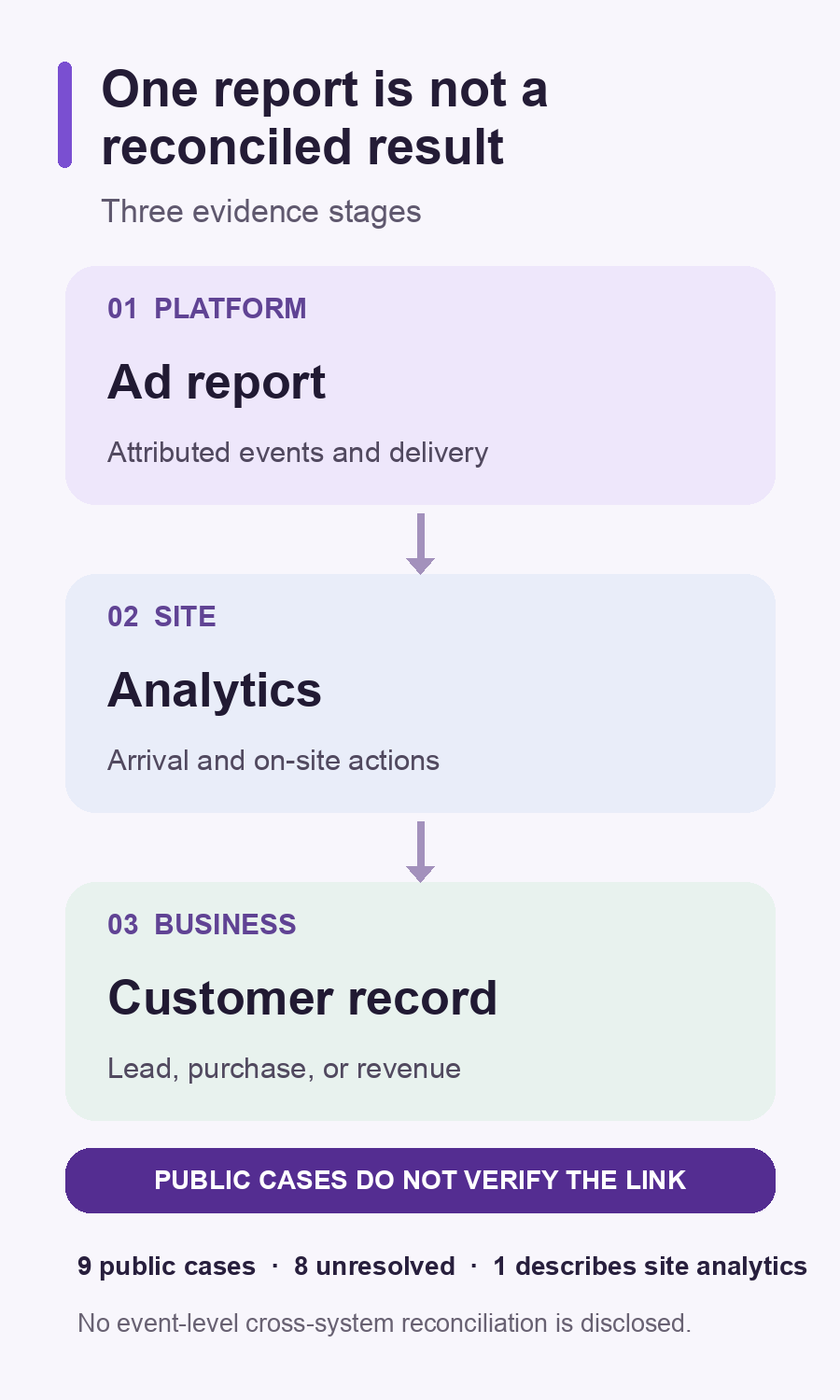
Figure 1. A platform report, a site observation, and a customer record answer different questions. In the nine reviewed public ChatGPT Ads records, eight measurement states are unresolved and one LegalNature story describes internal analytics; none publishes event-level cross-system reconciliation. Absence from a public story does not mean the advertiser never instrumented the field.
The third question is a decision rule, not a claim that every campaign must lead immediately to a purchase. An advertiser buying lead generation can define a qualified lead or booked consultation as its near-term outcome, then say explicitly what remains unknown about revenue. The requirement is to name the outcome and avoid swapping it for a more impressive but unverified one.
What the nine public cases actually show
Our fixed review covered Newegg, Stream, Jotform, and LegalNature. These are platform-published advertiser stories, not a random sample of advertisers or independently audited campaign exports. Six of the nine records have an outcome that can be cited individually with limitations; three Jotform optimization records were excluded after metric-definition review. No group meets the preregistered rule for a comparable cross-advertiser performance cell.
The public records have no record-level impression count, click count, conversion count, or revenue amount. That prevents an independent calculation of aggregate click-through rate, conversion rate, or return on investment. It also prevents a reader from pairing a reported outcome with the exact underlying events. A reported ROAS multiple is not a substitute for a revenue amount or an attribution audit.
LegalNature is the important exception to a blanket “no site measurement” statement. Its story says it used an internal analytics warehouse with last-click attribution for traffic from July 1 through August 23, 2026. That supports the narrower claim that an off-platform analytics source was described. The story does not publish raw events, join keys, or a reconciliation against the ad platform and a customer ledger. We therefore cannot call its outcomes independently audited or incremental.
| State | What the evidence would need to show | What the public review can say |
|---|---|---|
| Platform-reported outcome | Named event, reported value, attribution rule, and reporting window | A source-reported result can be quoted with its definition and limits. |
| Site-side observation | Working analytics record of arrival and the named action | LegalNature describes an internal analytics warehouse; the other eight records do not document enough to classify their site-side state. |
| Business-system outcome | Lead, order, or revenue entry under a stated business definition | No reviewed case publishes an event-level join to a business record. |
| Cross-system reconciliation | The same eligible event connected across systems, with time zone, deduplication, and window rules | No reviewed case publishes this reconciliation. |
| Not reported | The selected public story does not supply the field | This says nothing conclusive about what the advertiser instrumented privately. |
The separate, documented Grow My Ads test shows why these states matter in an actual stop decision. It reported roughly $1,200 of spend, 92 clicks, and zero measured conversions, while a UTM error caused ChatGPT traffic to appear as Direct in GA4. As our earlier analysis explains, the advertiser could not independently check the platform-reported zero against clean site attribution. That missing check does not prove that a conversion occurred; it means the zero was not reconciled. This test is a separate anecdote, not a tenth row in the nine-record official-case review.
What OpenAI’s measurement tools can and cannot resolve
OpenAI’s current conversion-measurement guide describes sending events with the OpenAI Pixel, the Conversions API, or both. A shared event ID lets OpenAI deduplicate an event sent by both methods. The guide says matching may use the oppref click reference, eligible advanced matching information, and modeled measurement where available; events are evaluated against configured campaign conversions and the applicable attribution window.
Those are capabilities and matching rules, not proof that a particular advertiser deployed them correctly. A modeled or attributed event can be useful for platform optimization while still differing from a directly observed site action. A shared Pixel/CAPI event ID helps prevent duplicate platform events; a business still has to test whether its own lead or purchase record matches the event it intended to optimize for. Do not add a platform conversion count to a site count or treat the two as independent sales.
The Ads Manager reporting guide also documents conversion-event columns, click-through and eligible view-through attribution, and reporting delay. A recent zero may not be final while reporting catches up. A mature test records the report extraction time and the window used before comparing it with site and business data.
A measurement preflight before spending
This is a compact worksheet for a small, bounded test. It makes the unknowns explicit before an ad result becomes an investment verdict.
| Before launch, record | Why it matters | Evidence to inspect during the test |
|---|---|---|
| One primary conversion definition, plus a separately named business outcome | A page view, form submit, qualified lead, and paid customer cannot be silently exchanged | Event specification and a real test action in the site and business system |
| Pixel and/or Conversions API configuration, with event ID when both send the same action | Duplicate delivery can inflate the platform count | One test action appears once after deduplication, with its event ID retained for diagnosis |
Landing URL parameters, including oppref behavior and the site’s campaign tags | Redirects or broken tags can erase the site-side path | A clicked test URL reaches the intended page and remains identifiable in analytics |
| Attribution window, time zone, and reporting extraction time | Otherwise the same event can fall into different buckets or appear late | Two exports compared over the same eligible period after the documented lag |
| A reconciliation method and a declared missing-state label | It prevents “zero,” “not measured,” and “not reported” from collapsing into one result | Count of matched, unmatched, duplicated, and still-pending eligible events; no personal data in the published audit |
Then make the decision from the strongest verified outcome available. Stop a bounded test when the agreed budget or unit-economics threshold is crossed without a supported business result. Revise measurement first when a tag, event, deduplication, or join breaks; a broken check cannot turn a platform zero into an independently verified zero. Scale only when the conversion definition and business value are stable enough to support the next spend decision, with unresolved attribution stated. None of these actions requires pretending the public cases provide a channel-wide benchmark.
Method, limits, and correction policy
The unit of this audit is a public campaign or optimization record, not an account, user, click, or conversion. The nine records came from four official OpenAI customer stories captured for Violet’s September 2026 research packet. The retained registry and 19-field availability matrix were checked against exact source locators and a rights ledger. The new diagram is Violet’s original explanatory work, generated from a frozen claim map and audited source inputs; it does not reproduce advertiser creative or show a real conversion path.
This article cannot calculate how many actual events reconciled across platform, site, and business systems. It cannot infer that an undisclosed field was never measured. It cannot convert LegalNature’s platform-published description of internal analytics into independent verification. The Grow My Ads example comes from an already published, separately documented analysis and is not part of the nine-row case population.
The claim map and media manifest are retained locally at docs/research/2026-09-23-c5-m9-m10-claim-map-v1.json and docs/research/figures/c5-measurement-media-v1.figure.json. A material source change, newly disclosed event data, or coding error would require a dated re-review and a versioned correction rather than silently changing these states.
Bring the market problem into focus.
Turn social and market signals into an ecosystem-growth, go-to-market, or technical engagement built around the work your team needs.
Explore engagements